Quick answer: The China Digital Arrival Card is a free online entry declaration every traveler to mainland China must complete before arriving — but it is not a visa. U.S. citizens still need a China visa in their passport; the arrival card does not replace it. It takes a few minutes, generates a QR code for immigration, and can still be completed at the border if you forget.
Since November 20, 2025, there's a new step every visitor to mainland China has to complete before arriving: the China Digital Arrival Card (CDAC). It's free, it's online, and it has largely replaced the old paper card you used to fill out on the plane. Here's exactly what it is, who needs it, when and how to complete it — and the one thing travelers keep getting wrong: it is not a visa.
Need the visa itself, not just the arrival card? You can have your China visa submitted in person — we review the application, submit it at your consulate, and ship your passport back.
What the China Digital Arrival Card is
The CDAC is a free online entry declaration run by China's National Immigration Administration (NIA). You complete it before you travel; it collects standard immigration details — passport information, flight number, where you're staying, and the purpose of your visit — and generates a QR code that immigration officers scan when you land. It became the standard way to file your arrival information on November 20, 2025 — the old paper card now survives only as a fallback at the border (more on that below).
The arrival card is not a visa — you still need one
This is the part that trips people up. The Digital Arrival Card is an entry declaration, not a visa. U.S. citizens still need a China visa in their passport before they travel — there is no tourist visa-free entry, and the arrival card does not change that. They're two separate things:
Your China visa — arranged weeks ahead, through the online COVA application and an in-person submission at your assigned consulate. That's the part we handle.
Your arrival card — a quick, free form you complete yourself in the 72 hours before you fly.
If you show up with a completed arrival card but no valid visa, you will not be allowed to board.
Who needs to complete it
Almost everyone entering mainland China: tourists, business travelers, people entering under a visa-free arrangement, and transit passengers who plan to leave the airport. Each traveler needs their own card — including children and minors traveling with family.
Who is exempt
The filing site's own instructions screen lists exactly who is exempt:
Holders of a Foreign Permanent Resident ID Card (China "green card")
Non-Chinese nationals with a valid Mainland Travel Permit for Hong Kong or Macao
Travelers entering on a group (collective) visa or as part of a visa-free group arrangement — individual visa-free travelers still file
Direct transit passengers (under 24 hours) who stay inside the port's restricted zone and never clear immigration
Cruise passengers who arrive and depart on the same ship
Travelers eligible to use China's e-channel (automated immigration gates)
Foreign crew members, drivers, and other employees of transport vehicles
Individuals eligible for centralized submission of entry and exit documents (a courtesy arrangement — if this is you, you know)
If you're not sure whether an exemption applies to you, assume you need the card — it only takes a few minutes.
When to complete it
Fill it out within three days (72 hours) before you arrive in mainland China. The whole thing takes about 5 to 10 minutes. One important catch: once you submit it, you can't edit it. So wait until your flight and hotel details are final — if anything changes afterward, you simply submit a brand-new card.
How to fill it out
You complete the CDAC through the official National Immigration Administration channels:
The NIA website — on a computer or on your phone's browser
By scanning the official Arrival Card QR code
The standalone "NIA 12367" mobile app, or the same mini-program inside WeChat or Alipay
Step by step: what the filing screens look like
We walked the official NIA filing site and captured each screen, so you know exactly what to expect. (These are our own screenshots of s.nia.gov.cn — the mobile version at the same address works identically.)
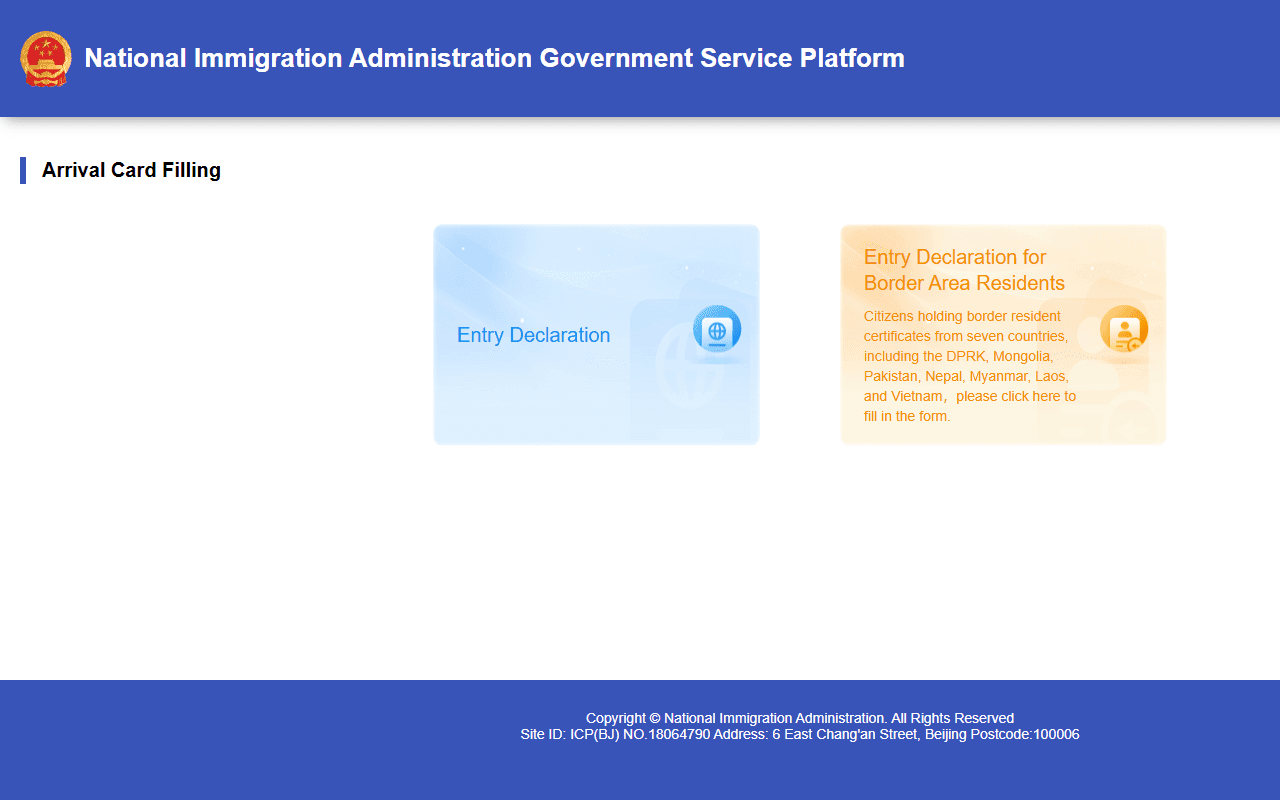
1. The landing page. Choose "Entry Declaration" — the second option is only for border-area residents of China's neighboring countries.
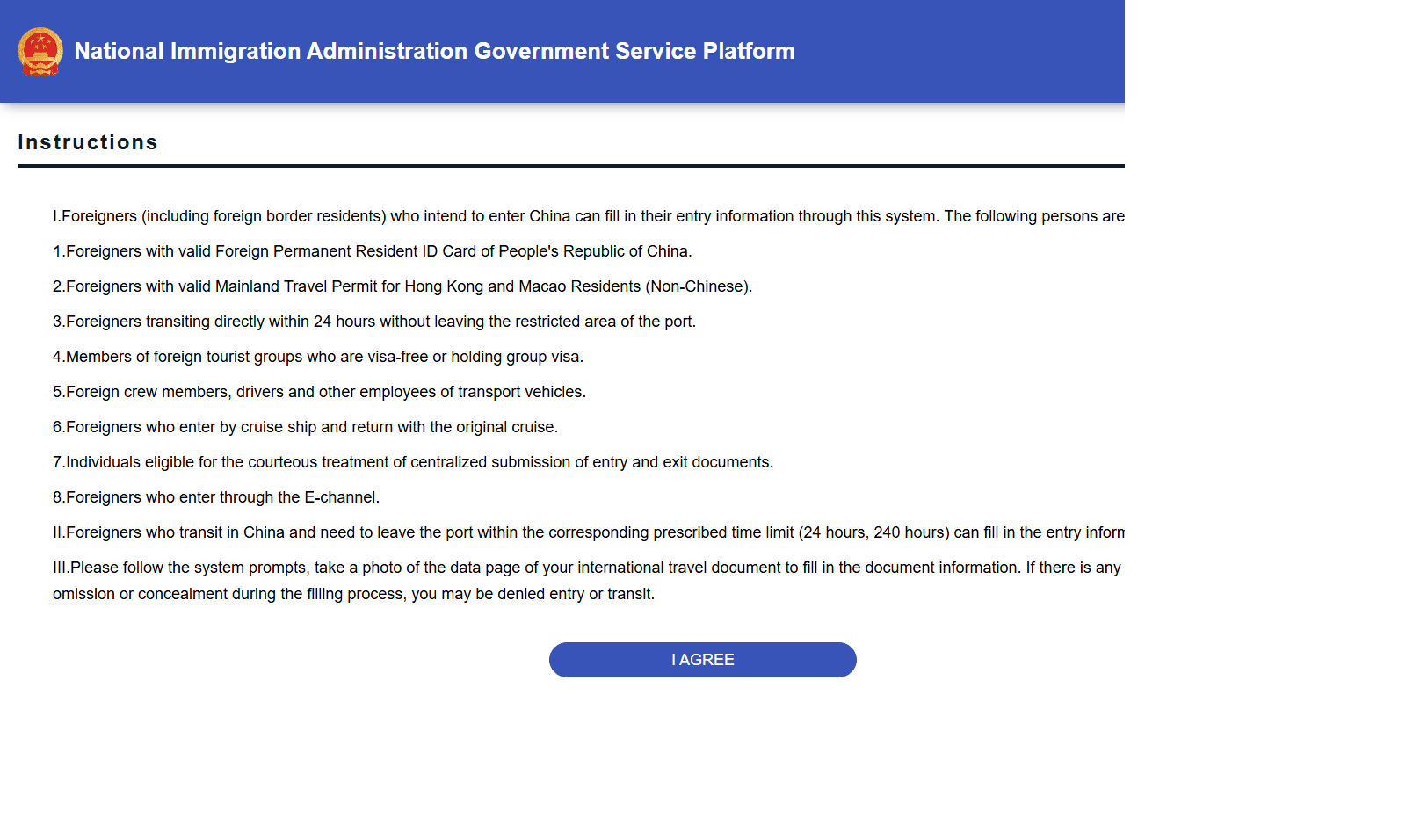
2. The instructions screen. Read it — this is the official exemption list (more below) and a warning worth taking seriously: omissions or false information during filling can get you denied entry or transit. Click "I AGREE" to continue.
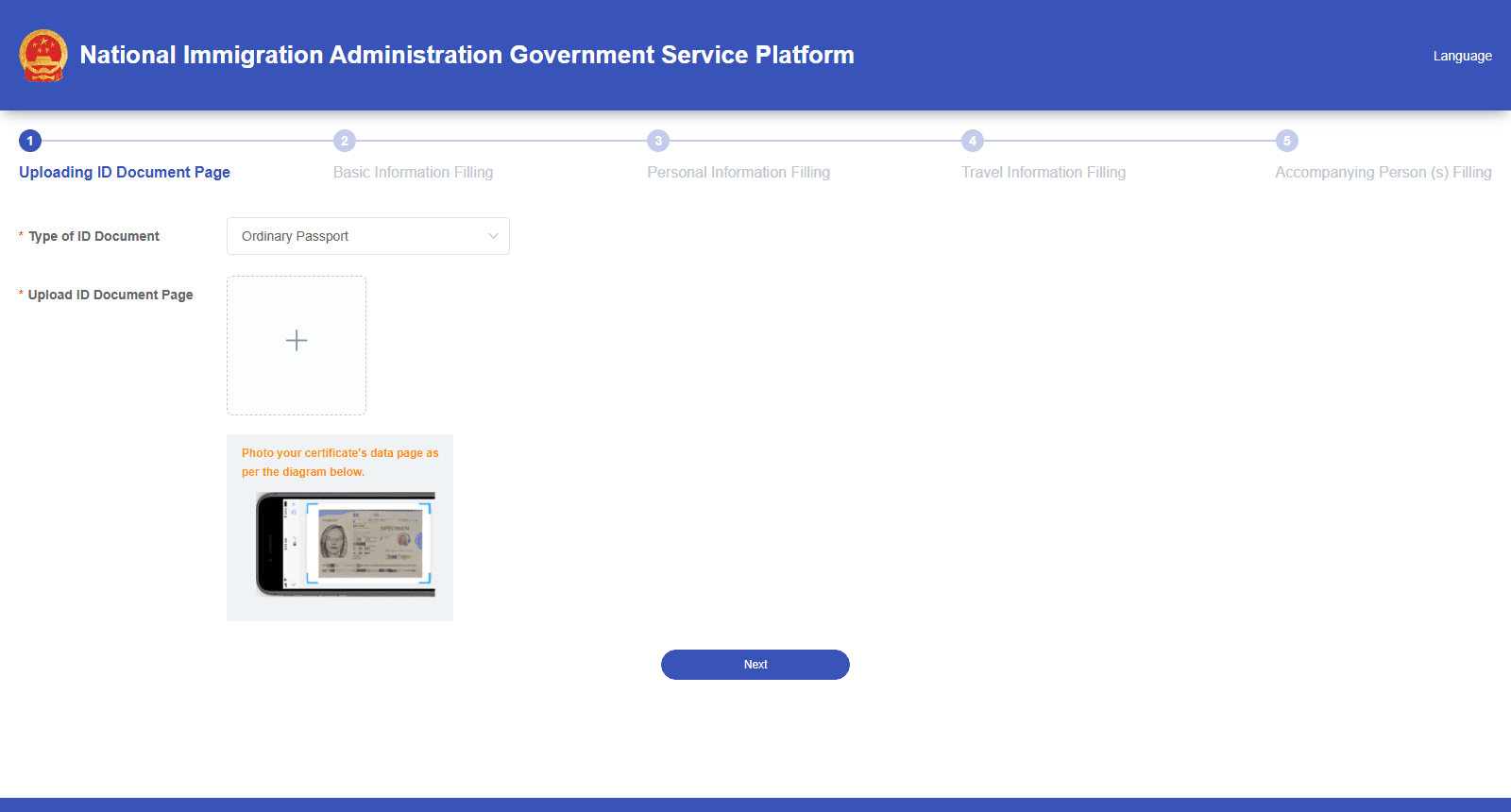
3. Step ① — upload your passport data page. Photograph it like the on-screen diagram (flat, all four corners visible). The system reads your details automatically and pre-fills the next screen.
4. Step ② — basic information. Confirm what the system read from your passport (name, gender, date of birth, citizenship, passport number), then add how you're arriving: transportation mode (flight, train, or vessel), your arrival flight number, and your city and port of entry. Have your booking confirmation open — the flight number needs to be exact.

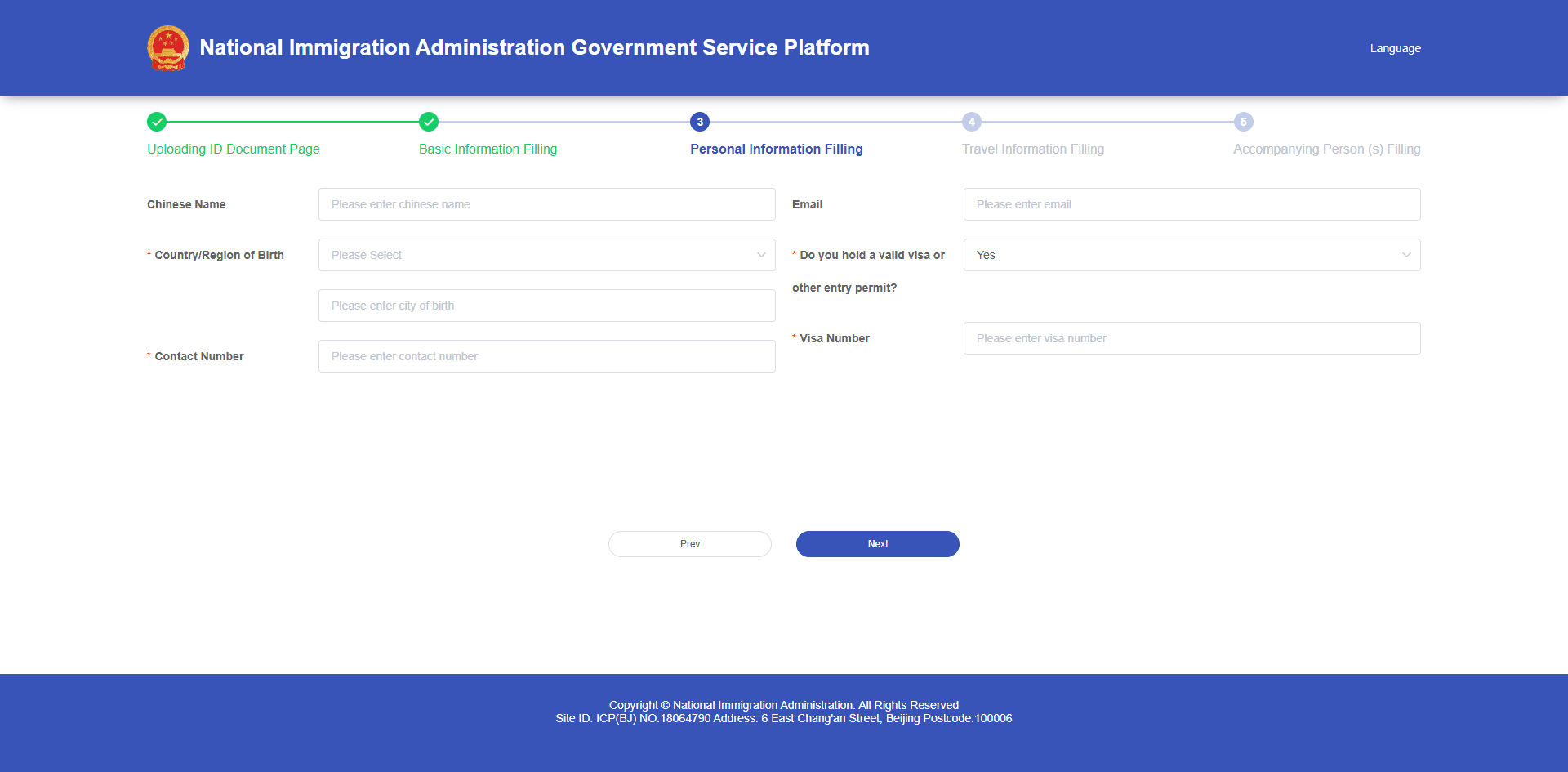
5. Step ③ — personal information. Country and city of birth, contact number, email — and here's the detail that surprises people: it asks whether you hold a valid visa and for your visa number. Translation: the arrival card comes after your visa, not instead of it. You'll find the visa number printed on the visa sticker in your passport. (A Chinese name field exists but is optional.)
6. Step ④ — travel information. Purpose of entry, date of entry, and your destination city — specifically "the city where you will stay the longest during this trip." Add your detailed address in China (your hotel is fine), any transit cities, whether you have inviting entities in China, and whether your departure itinerary is confirmed. None of the yes/no answers require documents at this stage.

7. Step ⑤ — accompanying persons, then submit. Traveling as a family? Add companions here so they're covered in the same filing. Solo travelers just hit Submit.
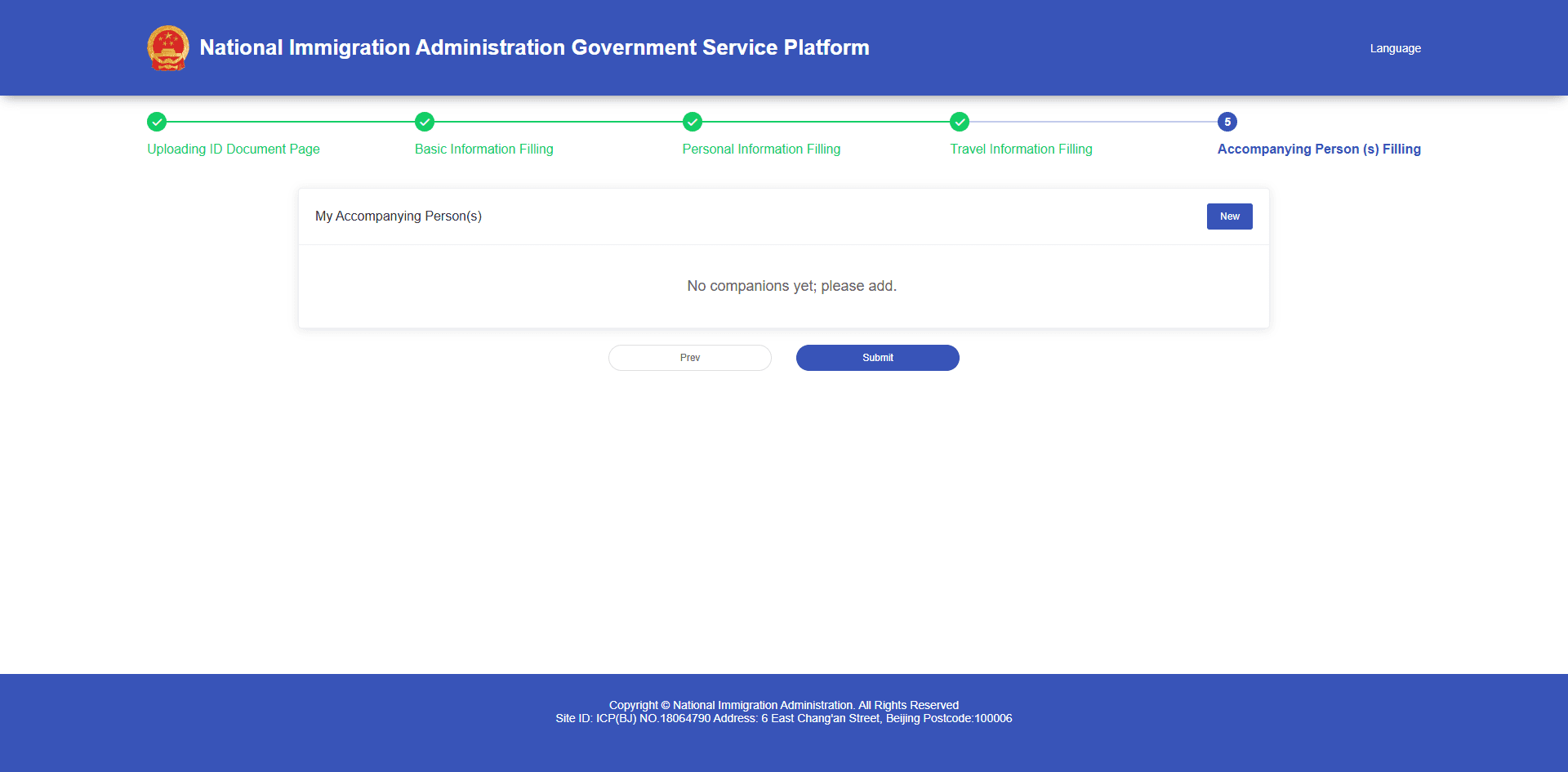
Sign the declaration, submit, and save your QR code (download it or have it emailed). Total time: about 5–10 minutes — most of it spent finding your flight number.
Forgot to file it? You can still complete it on arrival
If you couldn't pre-file — no internet, last-minute trip, or it simply slipped your mind — you won't be turned away. Chinese ports of entry let you complete the card on the spot: scan the arrival-card QR code on your phone, use one of the on-site smart terminals, or fill out a traditional paper card. (Confirmed in the Chinese Consulate's December 2025 notice.)
That said, doing paperwork after a 14-hour flight, in a line, is nobody's best moment. The 5 minutes it takes to pre-file in the 72-hour window before departure is the better trade.
Watch out: the arrival card is free
The CDAC is completely free. The NIA has publicly warned about scam websites that charge a fee to "submit" the arrival card for you — you don't need to pay anyone to complete it. Do it yourself on the official site or mini-program, close to your travel date.
Where we fit in
To be clear about what we do and don't do: we handle the hard part — your China visa — completing the COVA application and submitting your passport in person at your assigned consulate, weeks before you travel. The arrival card itself is a quick, free form you fill out yourself in the 72 hours before your flight; we always point travelers to the official NIA site for it, and our Full Service clients get a reminder so it doesn't get forgotten.
If you still need the visa that has to be in your passport before any of this matters, that's exactly what we do. Start your China visa application, see China visa options by state, or read our China visa COVA guide to understand step one.
Get My Passports is a private company that provides China visa application assistance. We're not affiliated with or endorsed by any government agency, and we do not file the Digital Arrival Card on your behalf — it's a free form you complete yourself through the National Immigration Administration. The details above reflect the rules as of 2026 and can change; always confirm the current requirements before you travel.