Quick answer: "The current applicant already has an application pending" means COVA has found an existing open application tied to your passport number. One passport can hold only one open application, so no new one can be created — by any account, agency, or consulate — until the first is closed. Resetting your password usually does not help, because COVA emails a code to the address on the original account.
Getting a China visa comes down to two big steps — and most of the trouble we see happens at the first one, before anyone ever gets near a consulate. Here's how the two steps work, why people get stuck at step one, and the one lockout scenario that can quietly trap your passport.
Wondering how long each stage actually takes? We measured the COVA review across more than a hundred of our own filings — see the current China visa processing times.
"The current applicant already has an application pending"
If you landed here because COVA refused your passport upload with this message, you are in the right place:
"The current applicant already has an application pending. Please do not submit another application."
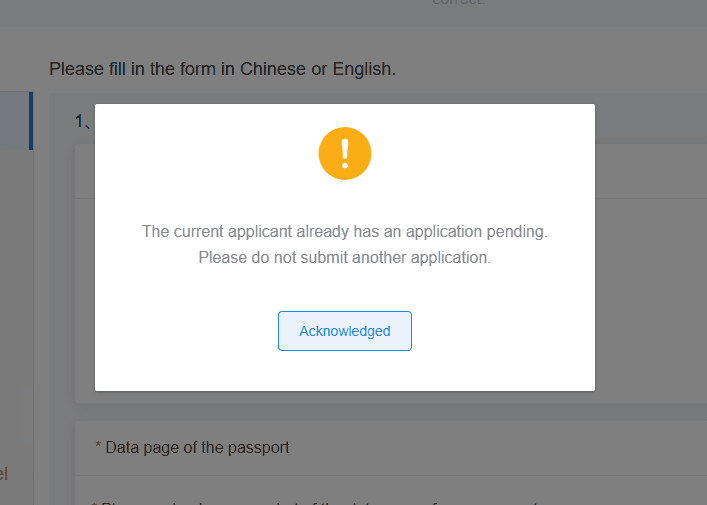
In plain English: COVA has found an existing, still-open application tied to your passport number — one that you, or someone applying on your behalf, started earlier. The system will not allow a second application to exist alongside it, no matter which account, which agency, or which consulate is trying to create it. Until that first application is closed out, your passport is effectively locked.
The two steps to a China visa
Complete the China Online Visa Application (COVA). You fill out your application on the COVA system and get the status to read "passport to be submitted."
Submit your passport to the consulate. Only once step one shows passport to be submitted can the passport go in for in-person submission at the consulate that serves your state.
Step two is the part everyone pictures. But plenty of applicants never make it past step one.
Why people get stuck at step one
A few things commonly stall an application before it can be submitted:
Missing or inconsistent information that has to be corrected before COVA will let the application move forward.
A passport that's out of validity (or too close to expiring), which stops the process cold.
Losing access to the COVA account you created — the one people overlook, and the hardest to fix.
The rule most people don't know: one application per passport
Here's what catches people off guard: COVA is built around a single active application per passport. When you create an account and start an application against your passport, that account becomes the only way back into that application — your passport is effectively tied to it.
So if you can't get back into the account, you can't simply start over. The existing application is still holding your passport.
Why resetting the password usually does not help
The obvious fix — recover the account — runs into a wall more often than people expect. COVA emails a one-time verification code to the address on the account every time you sign in. Not only for password resets: for ordinary log-in.
So if the application was created with an old work address, a school account, a mailbox you have since closed, or an address a previous agency set up on your behalf, there is no "forgot password" path that rescues you. No inbox means no code. No code means no way in. And because of the one-application-per-passport rule, you cannot simply start clean somewhere else either.
The worst case: locked out of your own COVA account
The situation we've watched trap people: they lose access to the COVA account they set up and can't get back in. Even after account-recovery attempts, sometimes there's just no way back into the original application — and because of the one-application-per-passport rule, that passport can't be used for a new application while the old one is still open.
It's a frustrating spot: the application is stuck, and so is the passport.
What if you do not know which consulate it was filed at?
This is where it gets genuinely difficult, and it happens more than you would think — especially when the first attempt was months ago, or was made by an agency that has since stopped answering. To withdraw an application, you generally have to approach the post that is holding it. If you cannot log in, you often cannot see which one that is.
China operates five visa-issuing posts in the United States — Washington D.C., New York, Chicago, San Francisco, and Los Angeles — and each handles only its own jurisdiction. Guessing wrong does not just waste a trip; it burns days you may not have.
How we free a stuck passport
When an account truly can't be recovered, the path that's worked for us is going straight to the consulate with a formal cancellation request — a letter asking them to cancel the stuck application. In our experience, that has released the passport so a fresh application can be started.
It isn't a one-click fix and the outcome is the consulate's call, but it's a route most applicants don't know exists — and one we've navigated before.
All five consulates, the same day
When the applicant does not know where the file sits, we do not guess. We have couriers in all five consulate cities, so the withdrawal request can be presented in Washington D.C., New York, Chicago, San Francisco, and Los Angeles on the same day — and whichever post actually holds the application is the one that responds.
Two recent cases show how differently this can land:
The applicant with no email access. She had started an application herself, lost access to that email address completely, and was not sure where she had filed. We presented withdrawal letters at all five posts. Four had nothing on file. One did — and it turned out to be a consulate that did not even cover her state. It was cancelled there, and we filed a clean application at the correct consulate.
The applicant another agency could not unstick. Same lockout, except a different agency had already tried and failed to get the application released. We ran the same five-city withdrawal. The post holding it came back with something better than a cancellation: the application was already sitting at "passport to be submitted" — so instead of withdrawing it, we simply brought the passport in and finished it.
Neither outcome was a formality, and every decision here belongs to the consulate rather than to us. But being able to knock on all five doors at once is the part that is genuinely hard to do on your own.
Stuck at step one right now?
If your China visa application is stuck — missing information, a passport-validity problem, or a COVA account you can't get back into — this is exactly the kind of situation to call us about rather than fill out a form. Every locked-out case is a little different, and it's far faster to talk it through than to guess.
Call us at (708) 360-7277 and we'll figure out the quickest way to free your passport and get your application moving again. If you're just starting out, our China visa COVA guide walks through step one, and you can see all China visa options by state.
Get My Passports is a private company that provides China visa application assistance. We're not affiliated with or endorsed by any government agency, and we can't guarantee a cancellation or any particular outcome — those decisions rest with the consulate. The above reflects our own experience and procedures can change at any time.
Related China visa guides